SealoPrester™ — Aseptic Cartridge Closure SystemA PANACEA BIO CHEM TECHNOLOGY PLATFORMThe Panacea aseptic cartridge closure system
MENU

SEALOPRESTER™ — ASEPTIC CARTRIDGE CLOSURE SYSTEM — BY PANACEA BIO CHEM

SEALOPRESTER™ · ASEPTIC CARTRIDGE CLOSURE SYSTEM

Dual chamber cartridge sealing under vacuum — the SealoPrester™ Aseptic Cartridge Closure System

The machine that turns a dual chamber cartridge into a Lyoprester®

The machine that turns a dual chamber cartridge into a Lyoprester®. By the time a cartridge meets the SealoPrester, five days of work are already inside the glass — synthesised, formulated, filled, frozen and dried while levitating, vacuum-charged and argon-locked. All of that value sits behind two millimetres of aluminium cap that are not yet crimped. The SealoPrester exists for those two millimetres. Seal o’ Precision. Seal o’ Sterility.

The Aseptic Cartridge Closure System of the Panacea line.

The seal is the product: the SealoPrester™ closes the vacuum-charged, argon-locked dual-chamber cartridge and the Lyoprester is born.

SealoPrester boot video

THE OBJECT

Commodity glass — until it is closed

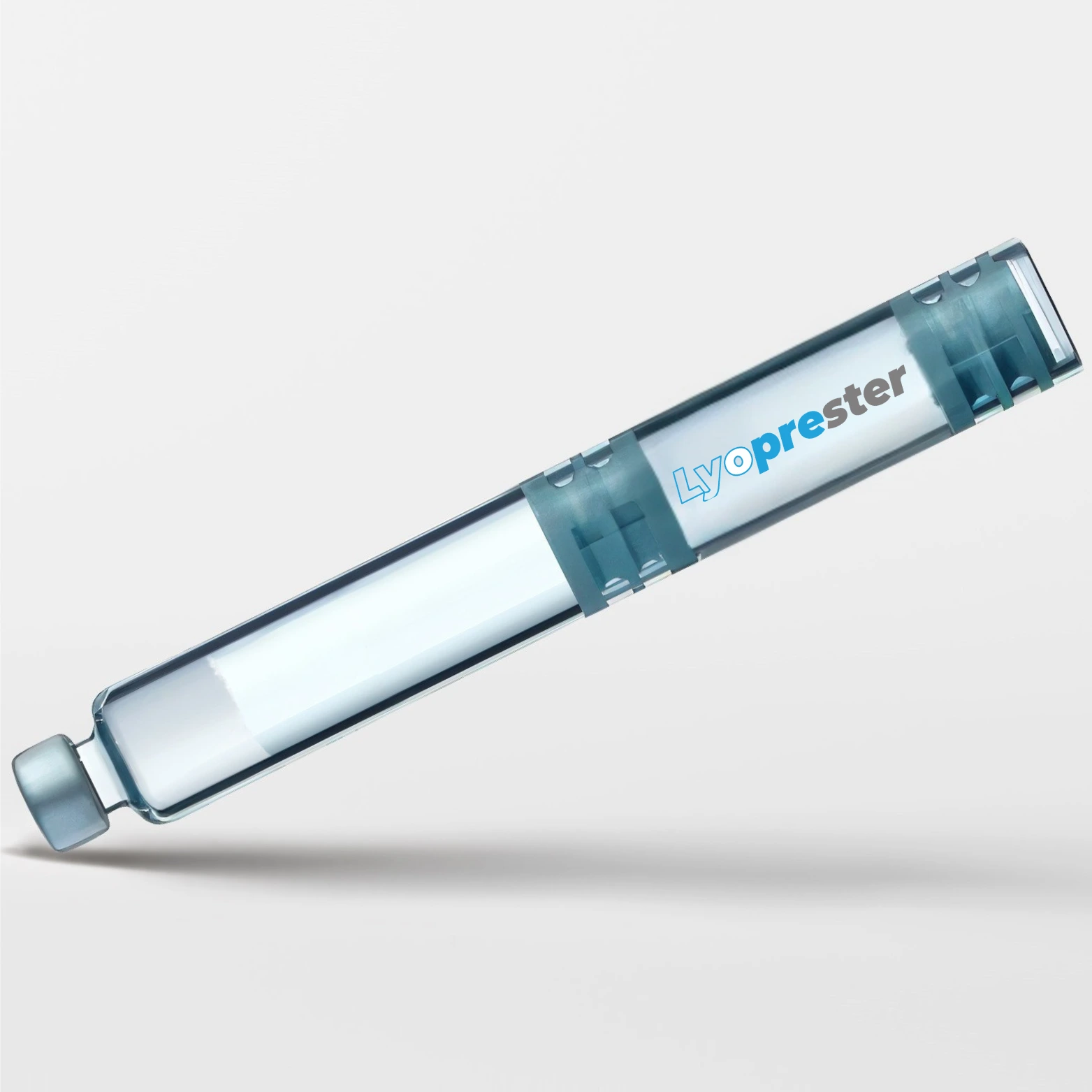
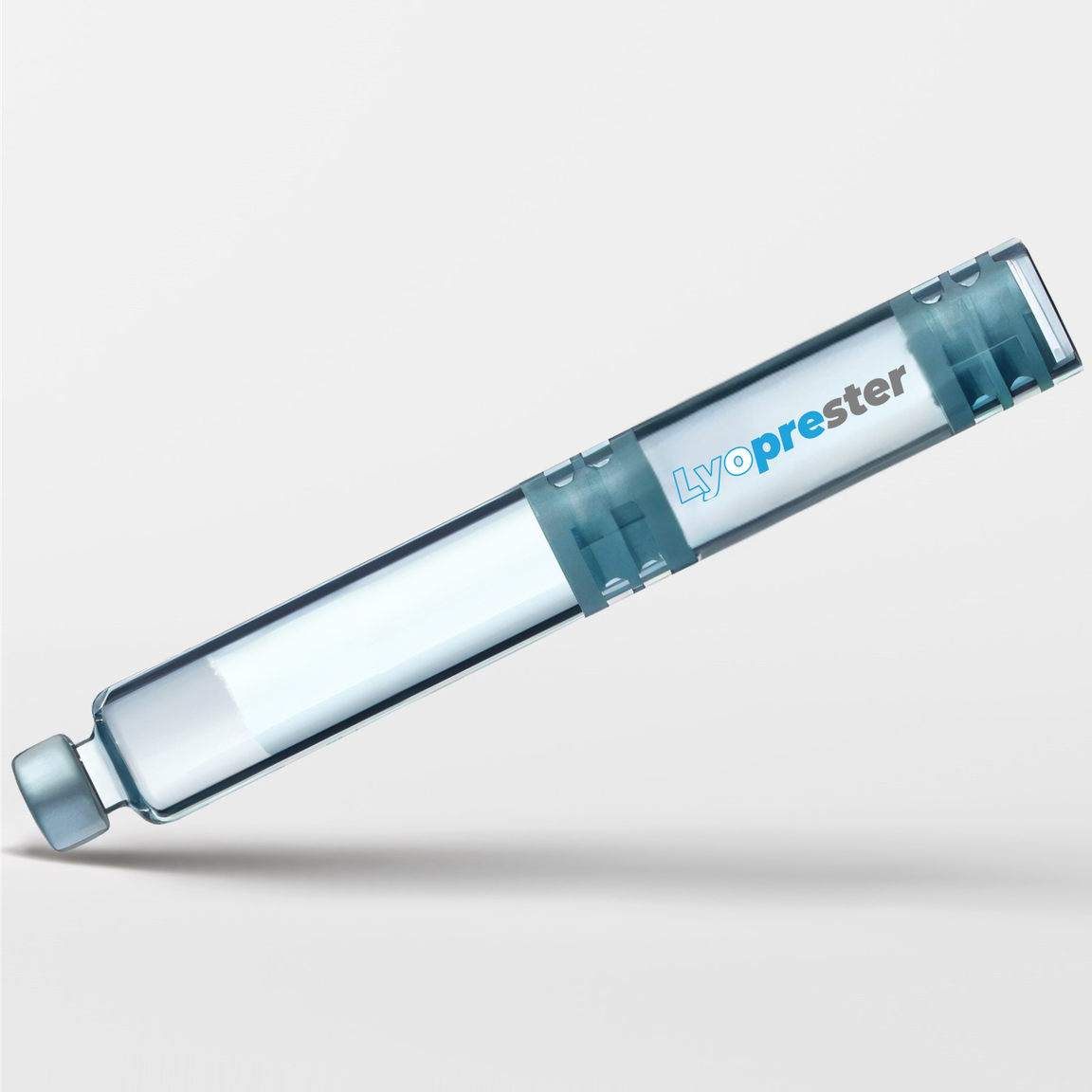
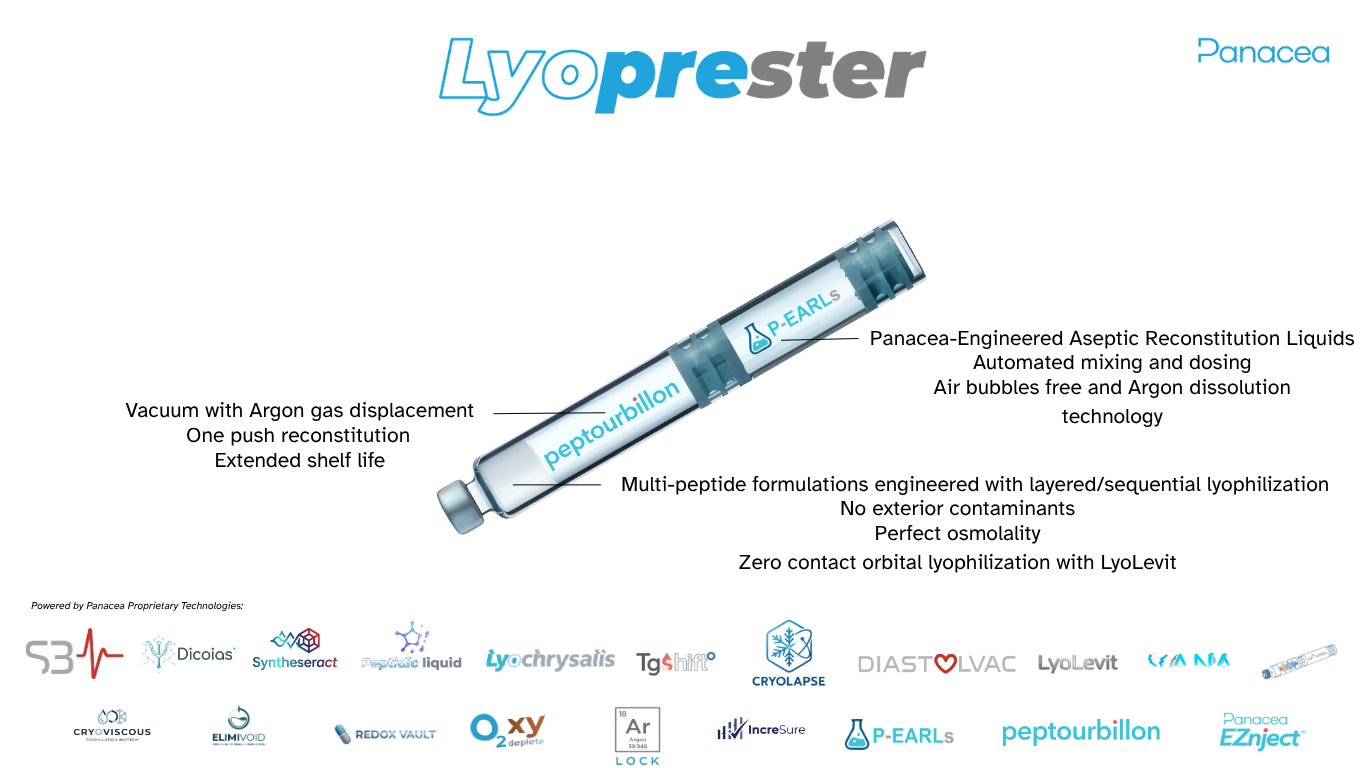
A dual chamber cartridge is commodity glass until the moment it is closed. What the SealoPrester seals is the finished Lyoprester®: vacuum-sealed, argon-locked, the cake dried by levitating lyophilization, the liquid chamber holding zero air bubbles — cake and liquid never meeting until the moment of use.

Dual chamber cartridge — the Lyoprester: vacuum-sealed, argon-locked, levitating lyophilization, zero air bubbles
The Lyoprester® dual chamber cartridge — the sealed format the SealoPrester produces.

THE SHORT ANSWER

The SealoPrester, in four sentences

The SealoPrester™ is Panacea’s Aseptic Cartridge Closure System — the cartridge crimping machine that applies the final mechanical seal to a dual chamber cartridge that is already vacuum-charged and argon-locked.

The cartridge arrives holding its breath: a lyophilized cake on one side, an engineered reconstitution liquid with zero air bubbles on the other, two plungers that must not move, and a cap held in place by nothing but the pressure difference across the glass.

The crimp window on that object is narrow — too little force and the seal is a leak path, too much and the chambers meet early — so the machine holds it with servo-controlled capping, vacuum cap handling, presence detection and recipe memory.

The seal is the product: the crimp is the last process step of the Lyoprester® itself, not its packaging.

CHAPTER 1

The last two millimetres of a five-day journey

By the time a cartridge meets the SealoPrester, five days of work are already inside the glass. The peptide was synthesised in continuous flow on the Syntheseract, formulated as a peptidic liquid with its cryoprotectants and scaffolders, filled by the PleniDose Gantry on a fixed datum, frozen with an RF-formed tunnel through the cake, and dried while levitating — finished cold, at −5 °C, where the industry would have cooked it at +50 °C.

All of that value sits behind two millimetres of aluminium cap that are not yet crimped. The SealoPrester exists for those two millimetres.

CHAPTER 2

The ticking bomb

What arrives at the sealing station is not a container. It is a charged device.

One chamber holds the lyophilised cake. The other holds its P-EARLs — the engineered reconstitution liquid, degassed before aliquoting so that no air bubble ever forms in it. Between them sits the middle plunger, the only thing keeping two worlds apart. Above: a cap and a top plunger placed under vacuum, held in place by nothing but the pressure difference between the argon-trimmed vacuum inside and the full atmosphere pressing in.

Bump the middle plunger a hair and the chambers meet — the cartridge reconstitutes itself, days of process gone in a second. Let the cap slip and the vacuum and argon sigh out, and the cake begins to die. This is the object the SealoPrester picks up, and it picks it up like what it is: the most delicate moment in the whole line.

CHAPTER 3

The relay — how the closure is born (with VANA)

The seal begins before the SealoPrester ever touches the cartridge. Inside the Lyochrysalis, in its VANA mode, the same chamber that dried the cake becomes the capping station. The cartridges go in open — cake dried, middle plungers and P-EARLs aliquoted by the PleniDose, but no top plunger, no cap.

The chamber draws down to just before the liquid would boil under vacuum — and holds there, never past it. Then argon is admitted: ArgonLock. The argon does not sit above the product like a blanket; it dissolves into the P-EARLs and into the cake itself, driving out the dissolved oxygen that would otherwise spend years quietly reacting with the peptide. Then, still inside that trimmed, inert atmosphere, the machine seats the top plunger and the cap. The Lyoprester becomes a closed system before it ever sees air.

Only then does the chamber vent, the cartridges come out — caps held by vacuum alone — and the relay passes to the SealoPrester. VANA closes the system in an inert atmosphere; the SealoPrester makes that closure permanent.

CHAPTER 4

Precision is not a slogan

The crimp window on a vacuum-charged dual chamber cartridge is narrow. Too little force and the seal is a leak path waiting for a shelf. Too much, and the stopper deforms — or the middle plunger shifts and the chambers meet. This is what separates a cartridge crimping machine built for live vacuum from an ordinary vial crimper: the container it meets is already pressurized against it.

The SealoPrester holds that window with servo-controlled capping, programmable speed and time profiles per format, vacuum cap handling, cap-presence and cartridge detection, and recipe memory for every product it runs. A generic capper crimps what it is given. The SealoPrester crimps what must not be disturbed — perfectly synchronized, because the cartridge at that moment can still be lost two different ways.

Servo-controlled capping
the crimp force window held, not estimated
Programmable speed & time profiles
the approach as gentle as the seal is final
Vacuum cap handling
the cap never lifted off its vacuum seat
Cap-presence & cartridge detection
no crimp on an empty position
Recipe memory
every format it runs, recalled exactly

THE OBJECT

The dual chamber cartridge, up close

Dual chamber cartridge — the Lyoprester: two chambers, two plungers, vacuum-sealed, argon-locked, zero air bubbles
The Lyoprester® dual chamber cartridge — the sealed format the SealoPrester produces.

CHAPTER 5

The cold lineage

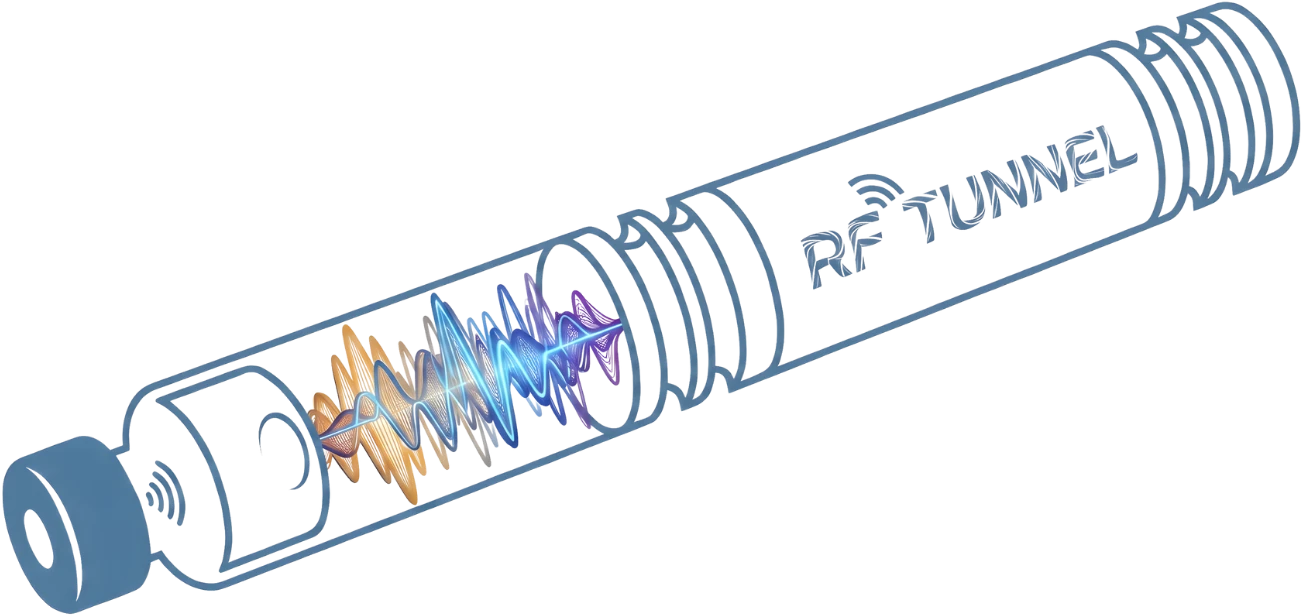
A closure this careful is the only worthy end to the gentlest drying process in the field. Upstream: the RF Tunnel forms the central channel through the frozen cake so reconstitution runs on geometry instead of surfactants; LyoLevit levitates and spins the cake for zero-contact drying; TgShift raises the glass transition so the cycle runs shorter, not hotter; and the Lyochrysalis finishes desorption at −5 °C to −3 °C — never the +40/+50 °C secondary bake that costs other processes their binding affinity.

Nothing that gentle deserves a brutal end.

CHAPTER 6

The name

Seal o’ Precision + Sterility → SealoPrester.

Precision for the crimp window on a live vacuum. Sterility for what the seal protects.

CHAPTER 7

In the line — fill → freeze → dry → charge → close → seal

Syntheseract (continuous-flow synthesis, CFSPPS) → the Peptidic Liquid (Dicoias Ψ design, Peptourbillon architecture) → PleniDose (fill on a fixed datum) → Lyochrysalis (RF Tunnel freeze, LyoLevit sublimation, cold desorption finish) → PleniDose again (middle plungers, P-EARLs aliquot) → VANA (vacuum to the boil margin, ArgonLock backfill, top plunger + cap) → SealoPrester (the permanent crimp) → Lyoprester® → the EZnject pen.

Every stage hands the next one a harder object to handle. The SealoPrester receives the hardest: the fully charged, fully closed, fully fragile cartridge. The full map — hardware, software and what each technology achieves — lives on the stack page.

Dual chamber cartridge technology family — every Panacea technology converging on the Lyoprester: vacuum charging, levitating lyophilization, zero air bubbles, argon lock
Every technology in the line converges on the Lyoprester — the SealoPrester closes it.

FROM THE PROGRAMME JOURNAL

Notes from the closure programme

Closure engineering

The ticking bomb: what a vacuum-charged dual-chamber cartridge demands of a crimping machine

The cartridge that arrives at the SealoPrester is not a container — it is a charged device: vacuum-charged, argon-locked, cap held by vacuum alone, two plungers that must not move. One wrong move and it reconstitutes itself or loses its atmosphere. This entry states the handling problem the machine was built around.

Bogdan Dicoias · 2026-08-17 · Panacea research programme

Line integration

The relay: VANA closes the system in an inert atmosphere, the SealoPrester locks it for the shelf

The closure is born inside the Lyochrysalis: vacuum to just-before-boiling, an argon backfill that dissolves into the P-EARLs and the cake, top plunger and cap seated under vacuum and argon. The chamber vents — and the closure physics placed must be made permanent. The hand-off, recorded.

Bogdan Dicoias · 2026-08-17 · Panacea research programme

Process doctrine

The cold lineage: why a closure this precise is the only worthy end to a dry this gentle

Upstream of the crimp, the Lyochrysalis finishes desorption at −5 °C to −3 °C — never the +40 °C/+50 °C secondary bake the rest of the industry calls normal. Binding affinity and bioavailability survive because the peptide was never cooked. The seal is where that investment is banked.

Bogdan Dicoias · 2026-08-17 · Panacea research programme

RESEARCH WATCH

Last updated: 2026-08-17

  • 2026-02

    Merck team publishes a physics model for spring-driven autoinjectors with dual-chamber cartridges

    Dual-chamber devices

    A modeling framework built on the equations of motion for the cartridge’s dual stoppers predicts injection time, stopper trajectories and maximum diluent volume for autoinjectors with dual-chamber cartridges — mainstream engineering confirmation that the two-plunger cartridge is a precision device whose behaviour lives and dies with plunger motion.

    Peer-reviewed study

    Drug Deliv Transl Res via PubMed ↗

  • 2019-10-30

    Dual chamber cartridges enter continuous pharmaceutical freeze-drying research

    Cartridge lyophilization

    The Ghent/Munich group adapted and experimentally verified a mechanistic primary-drying model for dual chamber cartridges in a continuous freeze-drying concept — spin-frozen cartridges dried without collapse, with drying time matching the model. Freeze-drying in the cartridge, not beside it, is an active research frontier.

    Peer-reviewed study

    Int J Pharm via PubMed ↗

  • 2019-03

    Laser-based headspace oxygen analysis qualified as CCI method for freeze-dried products

    Headspace oxygen & CCI

    Method development for container closure integrity testing of freeze-dried products in vials using laser-based headspace oxygen analysis — written in direct response to the revised USP <1207> chapters. Headspace gas composition is a measurable integrity property of a sealed freeze-dried container.

    Peer-reviewed study

    PDA J Pharm Sci Technol via PubMed ↗

  • 2019-05

    Four physical CCI methods and four artificial-leak types compared head to head

    Container closure integrity

    The first systematic comparison of helium leak, vacuum decay, laser-based headspace analysis and dye ingress against laser-drilled, wire and capillary leaks: helium leak is the sensitivity reference, and headspace analysis and vacuum decay both outperform dye ingress — the quantitative backbone of the deterministic-CCI era.

    Peer-reviewed study

    PDA J Pharm Sci Technol via PubMed ↗

  • 2015-01

    Vacuum decay matches up against dye ingress and high-voltage leak detection on pre-filled syringes

    Vacuum decay testing

    A case study on glass pre-filled syringes — the cartridge’s closest relative — benchmarked a non-destructive vacuum decay method against dye ingress and high-voltage leak detection across laser-drilled and capillary defects, following the FDA’s push toward deterministic physical CCI methods in stability protocols.

    Peer-reviewed study

    PDA J Pharm Sci Technol via PubMed ↗

  • 2011-09

    Vacuum decay leak test developed and characterized for a lyophilized product-package system

    Vacuum decay testing

    Method development work applying the vacuum decay container closure integrity test specifically to a lyophilized product-package system — the direct ancestor of the integrity logic this site describes: a freeze-dried, vacuum-held container announces a leaking closure on the gauge.

    Peer-reviewed study

    PDA J Pharm Sci Technol via PubMed ↗

  • 2019-03

    Fogging in lyophilized drug products investigated as a formulation-process property

    Lyophilization quality

    An investigation of the fogging behaviour seen on the walls of lyophilized drug product containers — part of the wider literature treating the freeze-dried cake and its container as one engineered system whose surfaces tell the story of the cycle.

    Peer-reviewed study

    J Pharm Sci via PubMed ↗

  • 1994-07

    The pressure inside lyophilization vials is time-dependent — documented three decades ago

    Vial headspace physics

    An early PDA Journal study of the time-dependence of pressure inside lyophilization vials — the classic evidence that the headspace of a freeze-dried, stoppered container is a dynamic, measurable system, not a static void. The physics the ArgonLock™ doctrine manages was already on the record in 1994.

    Peer-reviewed study

    PDA J Pharm Sci Technol via PubMed ↗

Bogdan Dicoias, inventor and biochemist at Panacea Bio Chem, designer of the SealoPrester aseptic cartridge closure system

Bogdan Dicoias — Panacea Bio Chem Ltd

THE FOUNDER

Designed inside the Panacea Bio Chem research universe

“A cartridge leaves the VANA chamber with its cap held by vacuum alone. From that second, the closure is not packaging — it is the last process step of the product itself.”

— Bogdan Dicoias — Inventor · Biochemist · AAC Designer — Panacea Bio Chem

FAQ

Frequently asked questions about dual chamber cartridge sealing

What is a dual chamber cartridge?

A dual-chamber cartridge is a glass cylinder divided into two chambers by a middle plunger, closed at the front by a septum cap and at the rear by a rear plunger. In the Lyoprester® format documented at lyoprester.com, one chamber holds a lyophilized cake — the freeze-dried peptide — and the other holds the reconstitution liquid; the two meet only at the moment of use, when the plungers advance and the liquid flows around the middle plunger into the cake chamber. The format exists because many peptide formulations fail in long-term liquid storage: keep the molecule dry and the solvent separate, and the shelf-life problem changes category. The dual chamber cartridge is also the standard format behind several auto-injector pens, which is why cartridge filling, closing and crimping are their own discipline in pharmaceutical engineering.

How are dual-chamber cartridges filled and sealed?

In the Panacea line, filling happens on the PleniDose™ gantry (plenidose.com): the rear plunger sets a fixed datum, the peptide formulation — the peptidic liquid, designed as described at peptidicliquid.com — is dosed into the front chamber, and after freeze-drying the middle plunger is inserted and the reconstitution liquid is aliquoted behind it. The ElimiVoid™ operation (elimivoid.com) removes the front void without moving the rear plunger, so no air bubble survives in the liquid chamber, and IncreSure™ (incresure.com) verifies the dose per pen increment. Sealing happens in two acts: the VANA mode of the Lyochrysalis chamber draws vacuum to just before the liquid’s boiling point, backfills argon, and seats the top plunger and cap while the cartridge is still under vacuum and argon; then the SealoPrester™ applies the permanent mechanical crimp to that cap. Vacuum closes the system; the crimp locks it for the shelf.

Why are cartridges closed under vacuum and argon?

Because oxygen is the enemy of shelf life and air is the enemy of the format. Trapped oxygen does not escape a sealed container — it reacts, oxidising methionine, cysteine, histidine and tryptophan residues in the peptide for as long as the product sits. This is the OxyDeplete™ doctrine (oxydeplete.com): remove the oxygen first and stability extends into years instead of months. Inert gas purging with argon goes further than a nitrogen flush: in the ArgonLock™ cycle (argonlock.com) the argon dissolves into the reconstitution liquid and the cake itself, displacing dissolved oxygen at the molecular level — the same principle that protects welding arcs and wine cellars, applied to peptides. The vacuum half of the charge does mechanical work: it holds the cap and plungers in place until the crimp lands, and it gives the finished cartridge a verifiable internal state — a headspace whose pressure and oxygen level can be measured without opening the container.

What is lyophilization (freeze drying)?

Lyophilization — freeze drying — is the removal of water from a frozen product by sublimation: the formulation is frozen, the chamber is evacuated, and ice passes directly from solid to vapour without melting, leaving a dry, porous cake that keeps the peptide’s structure intact. A cycle has three acts — freezing, primary drying (sublimation) and secondary drying (desorption of bound water) — and the temperatures of the last act are where products are won or lost. The Lyochrysalis™ chamber (lyochrysalis.com) finishes desorption at −5 °C to −3 °C, never the +40 °C/+50 °C secondary bake the rest of the industry calls normal, and the LyoLevit™ technology (lyolevit.com) dries the cake while it levitates, with zero container contact. Binding affinity and bioavailability survive because the peptide was never cooked. Freeze drying is what makes the dual-chamber format possible: a stable dry phase on one side, an engineered liquid on the other.

THE PANACEA TECHNOLOGY UNIVERSE

Twenty-six technologies, each the leader of its class

Proprietary Panacea Bio Chem Ltd technologies, invented by Bogdan Dicoias — what each one does, and why it leads its class.

Lyoprester® technology convergence — the Panacea Bio Chem technologies that meet inside one cartridge, invented by Bogdan Dicoias
  • Lyoprester® logo — Panacea Bio Chem technology by Bogdan Dicoias

    Lyoprester®

    The only dual-chamber cartridge that is autoreconstitution-enabled, vacuum-sealed and argon-fillback.

    Cake and liquid never meet until the moment of use — no contamination, no transfer, no compromise. A conventional vial wets only the surface; the Lyoprester carries Peptourbillon loads approaching 200 mg.

    Lyoprester SS: screw a needle, inject, throw.

    lyoprester.com ↗

  • P-EARLs logo — Panacea Bio Chem technology by Bogdan Dicoias

    P-EARLs™

    Panacea-Engineered Aseptic Reconstitution Liquid(s) — each tuned to the peptide it wakes.

    Bacteriostatic water is a fine diluent and nothing more. A P-EARL is engineered around the peptide’s pI-aggregation behaviour and its Met/Cys/His/Trp oxidation profile.

    GHK-Cu: a chelation-withholding liquid design, not generic water.

    p-earls.com ↗

  • Peptourbillon logo — Panacea Bio Chem technology by Bogdan Dicoias

    Peptourbillon™

    The layered peptide formulation architecture — single- or multi-layer, never a blend.

    Each active keeps its own lyophilised phase: near-eutectic layering, ultrasound freezing, −80 °C stack, RF-assisted drying. Chemistries that would destroy each other in a blend arrive as neighbours, not mixtures.

    Dual-layer cakes: one active below, a second above — one chamber, zero contact.

    peptourbillon.com ↗

  • RF Tunnel logo — Panacea Bio Chem technology by Bogdan Dicoias

    RF Tunnel™

    The RF-formed central channel through the cake.

    Two wetting fronts instead of one — reconstitution solved by geometry, not surfactants.

    The hard cases: heavy-loaded, lipidated (GLP-class) and gel-blocking APIs.

    rftunnel.com ↗

  • TgShift logo — Panacea Bio Chem technology by Bogdan Dicoias

    TgShift™

    Raises the cake’s glass-transition temperature with RF — instead of chilling below it.

    Drying runs warmer and faster while the structure stays below collapse — cycles shorten from days toward hours.

    Reference points: trehalose ≈ −29 °C, sucrose ≈ −32 °C — shifted upward, not endured.

    tgshift.com ↗

  • Cryolapse logo — Panacea Bio Chem technology by Bogdan Dicoias

    Cryolapse™

    Cryogenic pressure collapse under S3Pulse™ control — vapour redistributed through the whole cake, not its surface, impeding crust formation.

    A collapse, not a yank: vapour redistributes gently through the whole lyocake instead of being driven off its surface, which impedes crust formation. Cryopumping to −110 °C, surfactant-free.

    A representative peptide cycle pulled from ~13 hours toward ~4, without a surfactant in sight.

    cryolapse.com ↗

  • LyoLevit logo — Panacea Bio Chem technology by Bogdan Dicoias

    LyoLevit™

    The cake levitates and spins in high orbit — driven by ultrasound and RF.

    Company-reported zero-contact processing: 99% reproducibility, 89% energy reduction, a 4–6× gain in sublimation surface.

    No shelf contact means no hot spots — uniformity is the mechanism, not the hope.

    lyolevit.com ↗

  • Lyochrysalis logo — Panacea Bio Chem technology by Bogdan Dicoias

    Lyochrysalis™

    The integrated chamber housing the whole drying stack.

    It finishes cold — it never cooks the peptide. No +40/+60 °C secondary bake, so binding affinity and bioavailability survive.

    TgShift + LyoLevit + Cryolapse + DiastolVAC + S3Pulse in one housing.

    lyochrysalis.com ↗

  • S3Pulse logo — Panacea Bio Chem technology by Bogdan Dicoias

    S3Pulse™

    The control brain for every piece of Panacea hardware.

    Sixteen relay channels, three dipped product probes as the authority, Cryo-Triad event detection and a Kv-learning adaptive ramp — the only platform that enables every other technology.

    14,909 automated contract tests stand behind the control law.

    s3pulse.com ↗

  • Liquiprester logo — Panacea Bio Chem technology by Bogdan Dicoias

    Liquiprester™

    The single-liquid cartridge engineered so multiple peptide APIs coexist in one shared vehicle.

    The glass may vary, the dose must not: a fixed plunger datum with ElimiVoid, bore-variance self-counterbalancing, and IncreSure verification per increment.

    Dose accuracy that survives manufacturing tolerance — by design, not inspection.

    liquiprester.com ↗

  • Syntheseract logo — Panacea Bio Chem technology by Bogdan Dicoias

    Syntheseract™

    Continuous-flow peptide synthesis in a special, very fast and economical way.

    Batch synthesis is “more product, blindly”; Syntheseract is scalable production, observed — 64 positions, 128+ addresses, and a Digital Batch DNA for every run.

    Sprint, Economy and Fortress modes — the economics chosen per peptide, not per habit.

    syntheseract.com ↗

  • CFSPPS logo — Panacea Bio Chem technology by Bogdan Dicoias

    CFSPPS™

    Continuous-flow solid-phase peptide synthesis, written as its own category.

    Setpoint ≠ experience: in flow, every residue addition is observed and repeatable instead of assumed.

    The category reference the field reads before arguing.

    cfspps.com ↗

  • OxyDeplete logo — Panacea Bio Chem technology by Bogdan Dicoias

    OxyDeplete™

    Degassing plus no-headspace doctrine — the oxygen-starved seal.

    Trapped oxygen does not escape, it reacts. Remove it first and stability extends into years instead of months.

    Air seal vs oxygen-starved seal: the comparison the oxidation model is built on.

    oxydeplete.com ↗

  • ArgonLock logo — Panacea Bio Chem technology by Bogdan Dicoias

    ArgonLock™

    The final inert-atmosphere lock under argon.

    After drying, the cake is backfilled and sealed under argon — the principle that protects welding arcs, wine cellars and the Charters of Freedom, applied to peptides.

    Air vs vacuum-only vs ArgonLock — the three-face comparison, settled.

    argonlock.com ↗

  • RedoxVault logo — Panacea Bio Chem technology by Bogdan Dicoias

    RedoxVault™

    Separation, not merely suppression — redox isolation in lipid micro-reservoirs.

    A few ppb of iron can outweigh grams of antioxidant; the vault removes the catalyst from reach, with depot and delayed-release microsphere formats on top.

    A strongroom at the scale of a droplet — the ferritin principle, engineered.

    redoxvault.com ↗

  • PleniDose logo — Panacea Bio Chem technology by Bogdan Dicoias

    PleniDose™

    The shared filling gantry — one machine filling both the dual-chamber Lyoprester and the liquid Liquiprester.

    Only the rods holder changes between the two product lines; the rear-plunger datum is fixed and pen-compatible. The glass may vary — the dose must not.

    Known inside the machine software as the Lyochrysalis Gantry: one gantry, two product lines.

    plenidose.com ↗

  • IncreSure logo — Panacea Bio Chem technology by Bogdan Dicoias

    IncreSure™

    The dose-metrology layer — verified API per pen increment.

    The printed “60 IU” dial figure is not the API in the cartridge and not the volume per click. IncreSure characterises seven real pen parameters instead of trusting the label — a Cryolapse-enabled discipline.

    Piston travel per increment: measured, never assumed.

    incresure.com ↗

  • ElimiVoid logo — Panacea Bio Chem technology by Bogdan Dicoias

    ElimiVoid™

    Front-void elimination without touching the metered dose.

    It removes the compressible air pocket ahead of the dose — without moving the rear plunger, without withdrawing API, without changing the delivered increment. A Cryolapse-enabled operation.

    The completion liquid is API-free, buffer-free and engineered to stay out of the way.

    elimivoid.com ↗

  • Cryoviscous logo — Panacea Bio Chem technology by Bogdan Dicoias

    Cryoviscous™

    The characterised cold, high-viscosity, low-mobility conditioning state.

    The formulation is held temporarily still — strongly flow-restricted — for precision cartridge filling, then recovers within acceptance criteria on controlled warming.

    A processing state, not merely “cold liquid”.

    cryoviscous.com ↗

  • Vana Machine logo — Panacea Bio Chem technology by Bogdan Dicoias

    Vana Machine™

    Vacuum Assisted Needle Accessory — vacuum conditioning and plunger-locking for the cartridge.

    It prevents air gaps and plunger drift, landing the target vacuum inside the Lyopresters and keeping it there until the moment of use.

    The machine that vacuum-conditions the cartridge before it ever meets a needle.

    www.vanamachine.com ↗

  • EZnject logo — Panacea Bio Chem technology by Bogdan Dicoias

    EZnject™

    The disposable auto-injector pen built around the Lyoprester.

    One twist activates autoreconstitution — the P-EARLs is drawn into the peptide chamber at the septa. A hundred indexed 0.1 mL doses with lab-grade accuracy; ships with 31G/5 mm needles and a Peptourbillon pre-loaded.

    One twist — no vial, no syringe, no transfer.

    panaceaeznject.com ↗

  • Dicoias Ψ logo — Panacea Bio Chem technology by Bogdan Dicoias

    Dicoias Ψ

    The computed-chemistry advisory — every substance reduced to a vector across physical, electronic and formulation space.

    Structure-guided descriptors first, laboratory work second: the Ψ advisory ranks excipients, vehicles and layer candidates before the first bench run — the selection layer behind Panacea formulation decisions.

    The molecule’s structure reads the shortlist before the bench hears it.

    dcppsi.com ↗

  • SealoPrester logo — Panacea Bio Chem technology by Bogdan Dicoias

    SealoPrester™

    Aseptic Cartridge Closure System — Seal o’ Precision + Sterility.

    It mechanically seals the caps of vacuum-charged, argon-locked cartridges that arrive held together by vacuum alone — one wrong move and the cartridge self-reconstitutes or loses its atmosphere. In cahoots with VANA, it gives birth to the Lyoprester.

    The machine that turns a banal dual-chamber cartridge into a Lyoprester.

    sealoprester.com ↗

  • Peptidic Liquid logo — Panacea Bio Chem technology by Bogdan Dicoias

    Peptidic Liquid

    The peptide formulation in solution — the active plus its buffers, cryoprotectants, lyoprotectants and scaffolders.

    A peptide is only as good as the liquid it lives in: this is the formulation that decides whether a dose survives freezing, drying, storage and the journey back to solution. Designed with Dicoias Ψ.

    The liquid every Lyoprester is born from and every Liquiprester keeps.

    peptidicliquid.com ↗

  • DiastolVAC logo — Panacea Bio Chem technology by Bogdan Dicoias

    DiastolVAC™

    Biomimetic diastolic vacuum control — the pneumatic circulatory system of the machine: pumps, valves and sensors as one ensemble.

    The heart fills by gentle pressure difference, not by force. DiastolVAC governs freeze-dry pressure the same way — sensor-led, gradual — instead of the brute pump-draw that flash-boils a fragile cake or collapses it. It is what makes Lyochrysalis an advanced lyophilizer under S3Pulse control.

    Not one valve and not one pump — the whole pneumatic system, breathing in diastole.

    diastolvac.com ↗

  • KineticON logo — Panacea Bio Chem technology by Bogdan Dicoias

    KineticON™

    Motion Integrity Architecture — the motion-control layer that lets the machine know what happened on every axis move.

    Important motion runs as a persistent transaction (MotionProof), coordinate frames carry identities and histories (FrameProof), and every position comes back with its provenance (StateWitness) — the controller layer owned by the machine builder, not a vendor black box.

    Born on the PleniDose gantry, where the machine builder took ownership of the controller layer.

    kineticon.org ↗

Seal o' Precision. Seal o' Sterility.

The seal is the product.